Hi, I'm Meghana Dixit
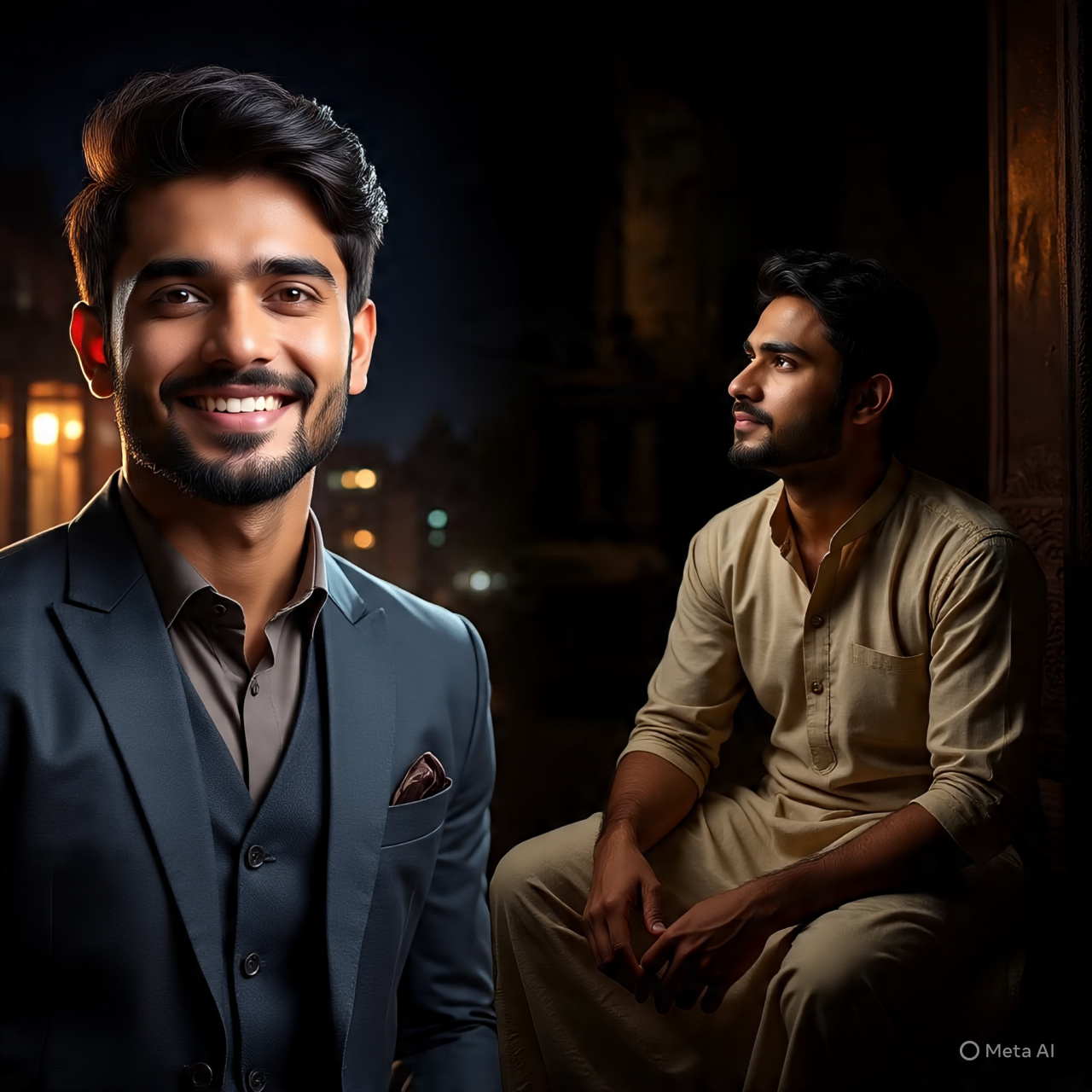
I am an Artist, who considers crossdressing as an Art !!! With Passion For Makeup, Glamour and Style. I myself am made of entirely of flaws, stitched together with good intensions.
As Queen Amuktha's growing distrust of men began creating divisions throughout Rajamahendravaram, the retired king Raja Ravindra became deeply worried about the future of his kingdom. Seeking guidance, he turned to his loyal former Prime Minister, who realized that Amuktha's actions were rooted in emotional wounds rather than poor leadership. After weeks of thought, the Prime Minister invited the king to a Kuchipudi performance where his talented son, Gajanan, brilliantly portrayed Satyabhama in the famous Bhamakalapam. Captivated by the young artist's grace, intelligence, and wisdom, Raja Ravindra was further impressed when Gajanan effortlessly resolved a complex dispute between two merchants. Recognizing that Gajanan possessed the rare ability to understand people and heal emotional divisions, the king saw in him a ray of hope and the possible key to changing Amuktha's heart and restoring harmony to the kingdom.

I am an Artist, who considers crossdressing as an Art !!! With Passion For Makeup, Glamour and Style. I myself am made of entirely of flaws, stitched together with good intensions.
The days passed slowly in the palace of Rajamahendravaram, but for Raja Ravindra, each passing day brought a new burden to his heart.
Although he had handed over the throne to Queen Amuktha, he had never stopped caring about the kingdom he had spent his entire life building. Every morning, trusted servants, retired officials, village elders, and merchants would quietly bring news from different corners of the realm.
The reports troubled him deeply.
Some spoke of experienced administrators being dismissed simply because they were men. Others spoke of disputes within families growing more frequent. Village councils that had once settled matters peacefully were now divided by arguments. In some places, people had begun competing for power instead of working together.
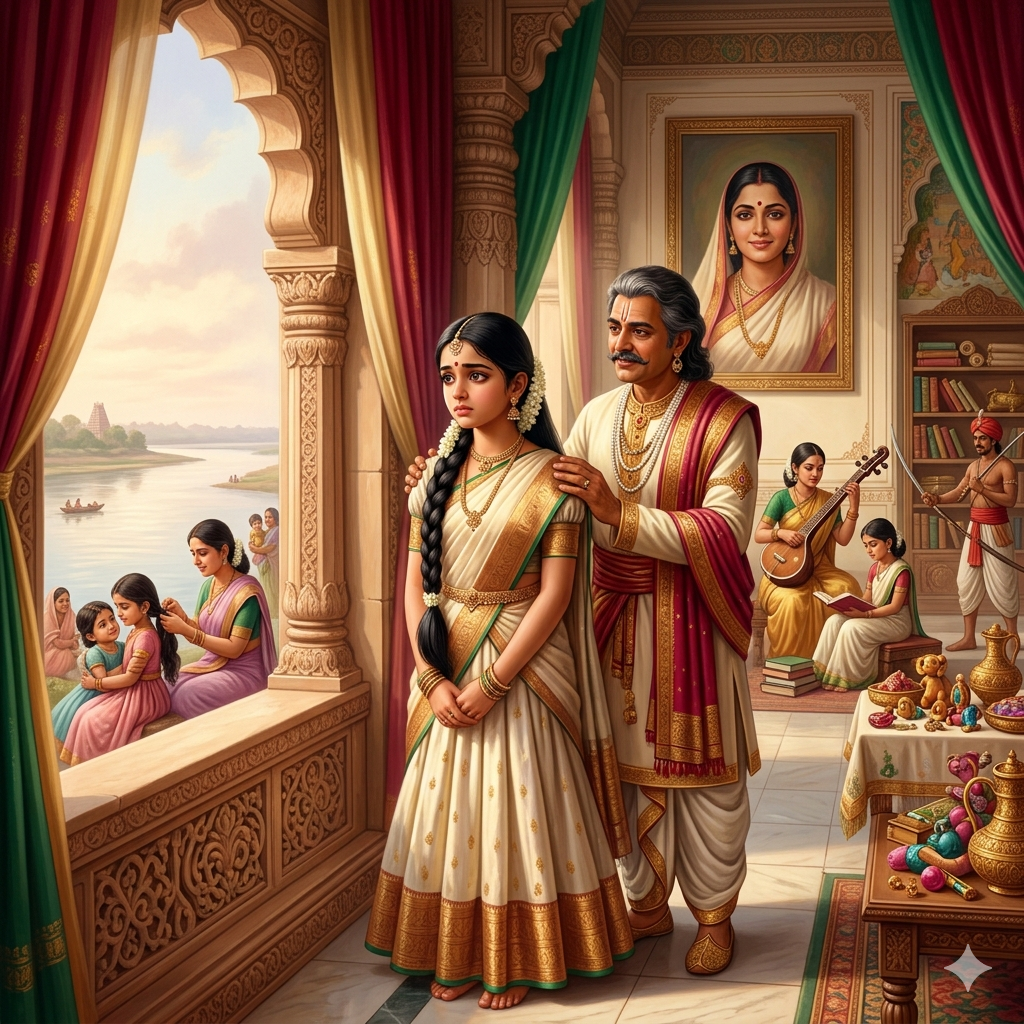
Raja Ravindra sat for hours in his private chamber overlooking the Godavari River.
The river still flowed peacefully.
The temples still echoed with prayers.
The markets remained crowded.
Yet something felt different.
The harmony that had once united the kingdom was slowly fading.
The old king knew his daughter was not evil.
Far from it.
Amuktha genuinely wished to improve the lives of women. She wanted to correct injustices that had existed for generations.
But somewhere along the way, her desire for justice had become mixed with anger and distrust.
And that worried him.
One evening, unable to bear the weight of his thoughts any longer, Raja Ravindra sent a messenger to summon the one man he trusted above all others.
His former Prime Minister.
The elderly minister had retired on the same day as the king. For nearly thirty years, he had stood beside Raja Ravindra through wars, droughts, celebrations, and political challenges.
More than an advisor, he had become a trusted friend.
When the minister arrived at the palace, the king welcomed him warmly.
The two old men sat beneath a carved wooden pavilion overlooking the royal gardens.
For some time, neither spoke.
Finally, Raja Ravindra broke the silence.
"My friend," he said softly, "for the first time in my life, I feel helpless."
The minister looked at him carefully.
The king continued.
"I can fight enemies."
"I can face famine."
"I can negotiate with rival rulers."
"But I do not know how to heal my daughter's wounded heart."
The minister listened quietly.
Raja Ravindra then shared everything.
The growing divisions.
The complaints from the people.
The increasing tension throughout the kingdom.
Most importantly, he spoke of Amuktha's inability to trust men.
When he finished, the minister remained silent for several moments.
His face showed deep concern.
Finally, he spoke.
"Your Majesty, this is not a problem of governance alone."
The king looked at him.
"It is a problem of perception."
"What do you mean?" asked Raja Ravindra.
The minister folded his hands thoughtfully.
"Someone whose heart has been hurt begins to see the entire world through that wound."
The king slowly nodded.
"Then tell me, how do we heal it?"
The minister thought for a moment.
"Give me some time, Maharaja."
"I believe I may have found a way."
The king agreed.
Days turned into weeks.
The minister disappeared from public view.
Even Raja Ravindra did not know what he was planning.
Then one morning, an invitation arrived.
The former Prime Minister requested the king's presence at a special cultural performance being held in a nearby town.
Though curious, Raja Ravindra accepted.
That evening, the king arrived at a beautifully decorated auditorium.
Hundreds of oil lamps illuminated the venue.
The fragrance of jasmine flowers filled the air.
Musicians sat upon the stage with their instruments.
Scholars, nobles, artists, and respected citizens had gathered to witness the performance.
Forgot his troubles.For the first time in months, he simply enjoyed the beauty of art.When the performance ended, the hall erupted with applause.The audience rose to their feet.
Soon the program began.
A lone dancer entered the stage.
The audience immediately fell silent.
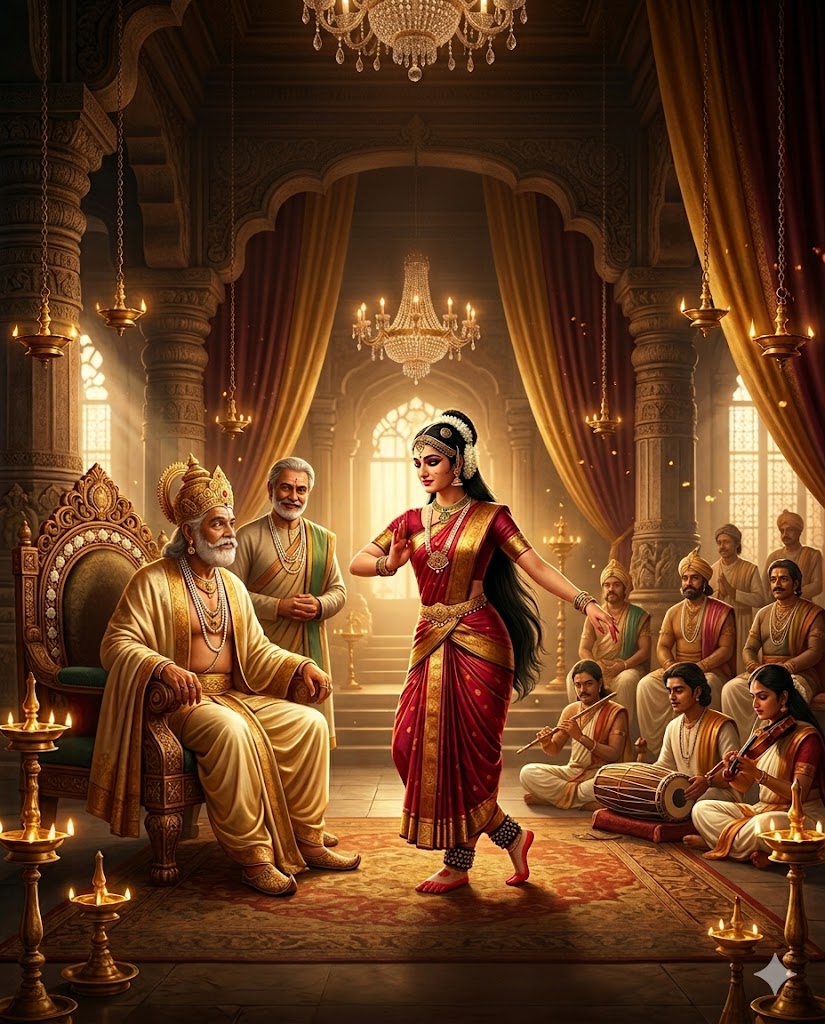
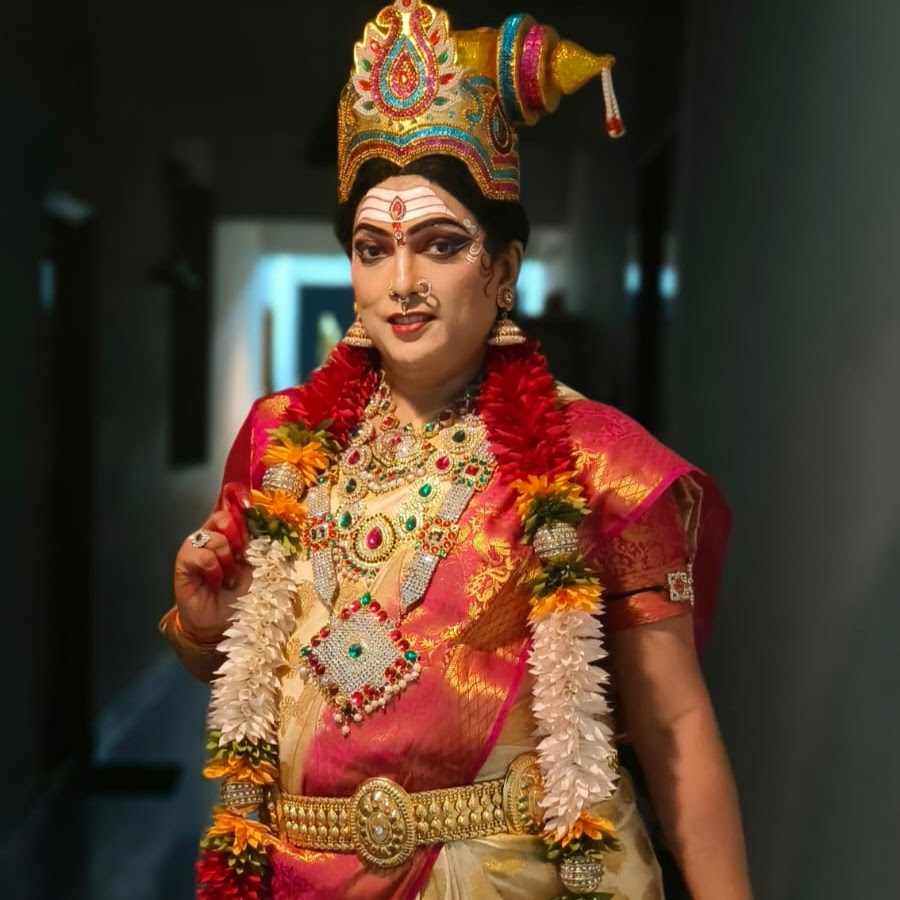
The performer was portraying Satyabhama from the famous Kuchipudi dance drama Bhamakalapam.
The dancer moved with extraordinary grace.
Every expression seemed alive.
Every gesture carried meaning.
The delicate movements of the eyes, the elegant turns of the wrists, the confident posture, and the emotional storytelling captivated everyone present.
Raja Ravindra found himself completely absorbed in the performance.
For nearly two hours, he watched in amazement.
The artist's beauty appeared almost divine under the warm glow of the lamps.
The character of Satyabhama seemed to have stepped directly out of legend.
The king forgot his worries.
Forgot politics.
Forgot his troubles.
For the first time in months, he simply enjoyed the beauty of art.
When the performance ended, the hall erupted with applause.
The audience rose to their feet.
The king himself joined them.
He could not stop admiring the remarkable talent he had witnessed.
After the event, the former Prime Minister approached him.
"Your Majesty," he said with a smile, "there is someone I would like you to meet."
The king nodded.
The minister led him backstage.
The performer stood there waiting respectfully.
Still dressed in elaborate costume and jewelry, the artist bowed before the king.
Raja Ravindra smiled warmly.
"You performed magnificently," he said.
"Your portrayal of Satyabhama was extraordinary."
The performer lowered their head respectfully.
Then the Prime Minister spoke.
"Maharaja, allow me to introduce my son, Gajanan."
The king blinked.
For a moment, he thought he had heard incorrectly.
"Your son?" he asked in surprise.
The minister smiled.
"Yes, Maharaja."
The king looked again.
Only now did he notice the subtle details he had overlooked during the performance.
The artist was indeed a young man.
Yet his mastery of expression, voice modulation, posture, and character portrayal had been so complete that nobody in the audience had questioned the role.
Raja Ravindra was astonished.
Gajanan smiled politely.
His voice was gentle and respectful.
His confidence was balanced by humility.
The king immediately felt impressed.
The next morning, Raja Ravindra invited both the Prime Minister and Gajanan to stay at the royal palace as honored guests.
Over the following days, the king spent considerable time speaking with the young artist.
The more he learned about Gajanan, the more impressed he became.
Gajanan was not merely a dancer.
He was educated in literature, philosophy, history, and statecraft.
He possessed remarkable emotional intelligence.
He understood people.
He listened carefully before speaking.
And most importantly, he never seemed eager to prove himself superior to anyone.
One afternoon, while they were discussing ancient stories in the royal garden, a palace official arrived in distress.
Two merchants were involved in a heated dispute regarding ownership of a valuable shipment.
The matter had become complicated.
Several administrators had failed to resolve it.
The official sought guidance from the king.
Before Raja Ravindra could respond, Gajanan respectfully requested permission to speak.
The king agreed.
Gajanan listened carefully to both sides.
He asked only a few questions.
Then he calmly identified the misunderstanding that had caused the entire conflict.
Within minutes, both merchants realized the truth.
The dispute ended peacefully.
The merchants thanked him and departed.
Raja Ravindra watched in amazement.
The solution had been so simple.
Yet none of the experienced officials had seen it.
The king turned toward Gajanan.
"My son," he said with genuine admiration, "how did you solve it so quickly?"
Gajanan smiled.
"Your Majesty, when people are angry, they focus only on defending themselves."
"But if someone listens without choosing sides, the truth often reveals itself."
The words struck Raja Ravindra deeply.
For a moment, he found himself thinking about Amuktha.
About the kingdom.
About the growing divide between men and women.
And for the first time in many months, a small spark of hope appeared in his heart.
Perhaps this remarkable young man had entered his life for a reason.
Perhaps the solution he had been searching for was finally beginning to reveal itself.
As the evening sun cast golden reflections upon the waters of the Godavari, Raja Ravindra looked toward Gajanan thoughtfully.
The old king did not yet know how this young artist would influence the future of Rajamahendravaram.
But destiny had quietly begun weaving their paths together.
And the story of Queen Amuktha was about to enter a new and unexpected chapter.
P.S: This is purely a work of fiction and no resemblance to the historical characters is intended.





No comments yet